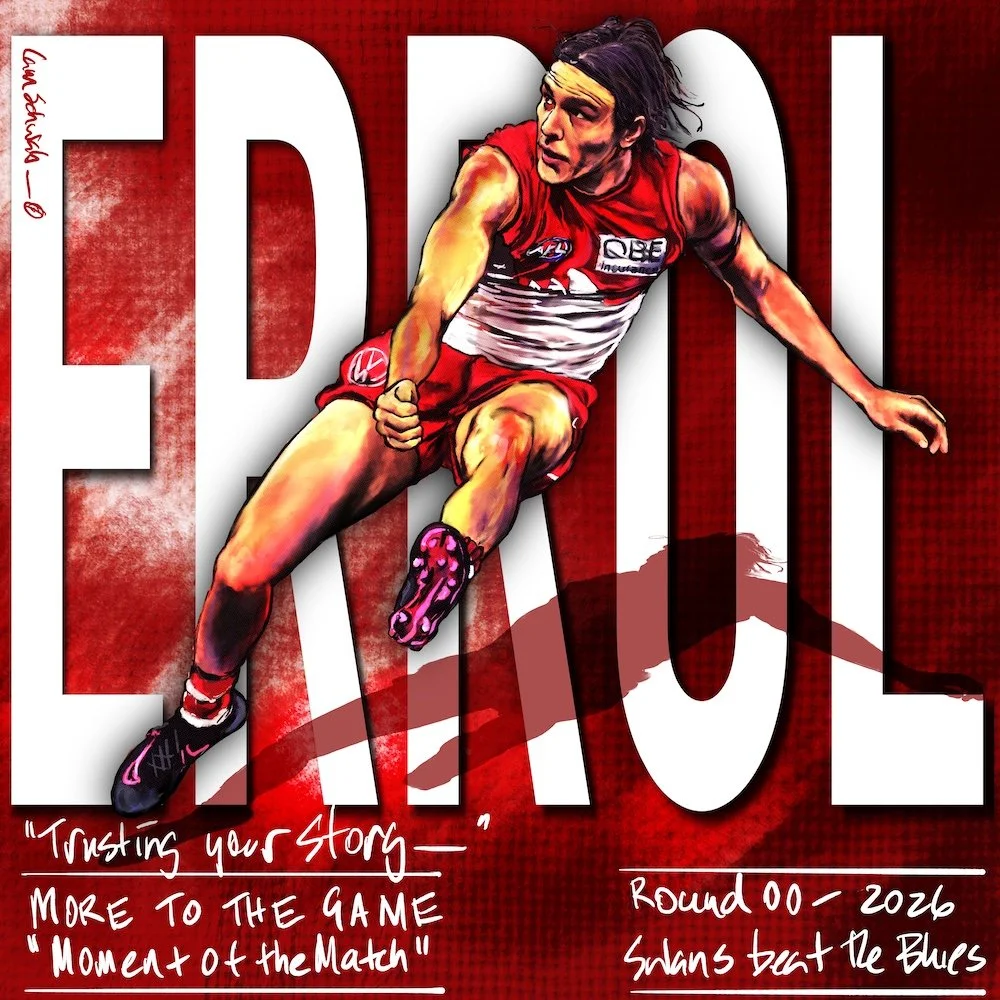
In the middle of all of it was Errol Gulden
One of my favourite AFL players who brings a very complete tool kit to our great game, and I am sure his coach was very happy that he was on the SCG turf, rather than in the grandstand, as he was too often last year.
When you stop trusting your own story, you hand your power to someone else's
Stories of achievement, when told as reflection after the silverware is safely locked in trophy cabinets and medals dangle around necks, carry a sense of destiny, almost inevitability, in the achievements of team and individual.
Told, and retold, with the wisdom of hindsight, offering motivation to the few who can see themselves not only in receipt of the accolades that accompany victory, but what the achievement will ask of them, the effort required to stay a journey with all of its efforts, setbacks, doubts and doubters.
To trust our story, even when it is forming and reforming, just the roughest outline, waiting to be coloured in.
A new season starts, testing the narratives, those formed inside the four walls of all clubs by leaders, seeking a theme that might just be the difference maker in binding a team, one whose dynamics amplify the mechanics that have been whiteboarded, analysed, debated, coached, systematised, practised and practised some more over the past few months.
They understand that good mechanics do not guarantee good dynamics, but you will never have good dynamics without good mechanics; it is dynamics that will be the difference maker.
The best themes survive until Grand Final day, still being spoken by coaches as a reminder of what the moment is asking of the players, what they have worked so hard for, what earned them the opportunity this day presents.
Last year, at half-time in the most statistically even Grand Final imaginable, we were given access to the words of Brisbane coach Chris Fagan as the players re-entered the arena. There was little talk of mechanics; it was all about the dynamics of the group.
Fages focused on selflessness and team-pressure. ”There will be no heroes here”, he said, and again urged his players to "Pound the rock", and Geelong will finally crack, and they did, and his Lions were back-to-back Premiers an hour or so later.
______
The story plays out like some kind of destiny, but it was anything but that, and, like any group of people trying to do something incredibly difficult together, doubts are inevitable.
We doubt the game plan, we doubt our culture, we doubt our leadership, we doubt each other, and of course, we doubt ourselves.
And it is a game of a thousand narratives, and many forms of feedback, all with a capacity to distract.
These narratives can dilute your trust in your story, effectively handing power to someone else's story of their own invention and therefore out of your control.
If Chris Fagan had lost trust in his story, he would never have coached an AFL game, let alone coached two Premierships as the only man never to have played AFL football in the modern game, and the oldest Premiership coach in the history of the sport.
And never think he didn't doubt himself. The power of his story is not just in the silverware; it is the humility with which he tells it. His story is so unlikely that it needs explanation, and Chris shares all his doubts, because in many ways, they are the story.
But he never ceded his story to anyone else.
It will always be his story.
And he tells it with gratitude, grace and generosity.
______
If it isn't happening in you, it won't happen through you.
With the opening round of the AFL season now played, won and lost, new narratives are spawned.
I read with interest the self-work Swans coach Dean Cox did in the off-season.
Last year, in his first season as head coach, the Swans missed the finals altogether. He was also an Assistant coach when Brisbane belted Sydney in the Grand Final the season before. This loss added further weight to another narrative, one of failure on the biggest stage. It was the Swans' fourth Grand Final loss in a decade, three by ten goals or more.
Whilst it is not unique for coaches to take themselves on off-season sojourns of discovery, always seeking an edge collectively or personally, I liked what I read about his efforts.
After a season of disappointment, including unmet expectations and all its recriminations, it is easy to drown in a sea of regret, of decisions taken, choices made, and your behavioural responses.
Regret, in my experience, is a form of blame, and blame is the most toxic response of any leader seeking to build a high-performance environment, one that can build a story it can trust across a year and the years following.
And blame, even self-blame, attracts a crowd, and offers nothing by way of solution.
As a leader, self-blame too often became my default position, and I needed to find an antidote.
A simple reframe made a great difference.
I changed from 'regret' to 'reflection'.
To face our doubts and their lessons.
Doubt is not only inevitable — it is required, and it needs to be systematically embedded in your leadership practice.
A practice of reflection.
It means always generating and gathering feedback. We need to collect the dots in order to join the dots.
What is the world telling us?
What are we doing well?
What would we do differently if we had our time again?
Are we on track?
Are we on the right track?
And this is exactly what Dean Cox did. Armed with feedback from those who matter, including his players, and by embedding himself in high-performance environments (e.g., the New Zealand All-Blacks) as a student rather than a teacher, he renewed trust in his own story and that of his team and club.
As Fages says, “If you want your players to be coachable, you've got to be coachable yourself.” Dean Cox has embraced this mantra.
Of course, he had to make adjustments; that is the very reason for the exercise itself, but do so, not as a regret of past efforts, but as a reflection of the gifts they now offer.
He was doing the work in him, so it could happen through him.
Time will be the test, of course, but they are off to a nice start. After a shaky first half against a Carlton team that was playing very well, reducing the Swans to something far less than their ability suggested, they turned it on like few can, with a 12-goal third quarter, and it was game over in the blink of an eye.
In the middle of all of it was Errol Gulden, who my drawing celebrates, one of my favourite AFL players who brings a very complete tool kit to our great game, and I am sure his coach was very happy that he was on the SCG turf, rather than in the grandstand, as he was too often last year.
______
All good strategy comes from a compelling story.
The compelling story is the believable story.
To trust our story means we need to reflect on our story. A practice of reflection is the mechanics of leadership, giving the leader the best opportunity to create the dynamics.
There is no other way.
And for any leader reading this, grab a pen and notebook, and write down this double-barrelled question, and then set about answering it:
"Do you believe in your people, and do they believe in you?"
The Swans looked like a team that believes in its story and is determined to own it.
Play on!

My work builds on the belief that leadership is the defining characteristic of every great organisation or team.
You cannot outperform your leadership.
Our offering is designed for leaders who know that personal leadership effectiveness drives team and organisational performance and that there must be a better, more efficient and effective way to learn leadership.
Feel free to connect, or make contact