Round #24 - If it was really good, what would it be like?
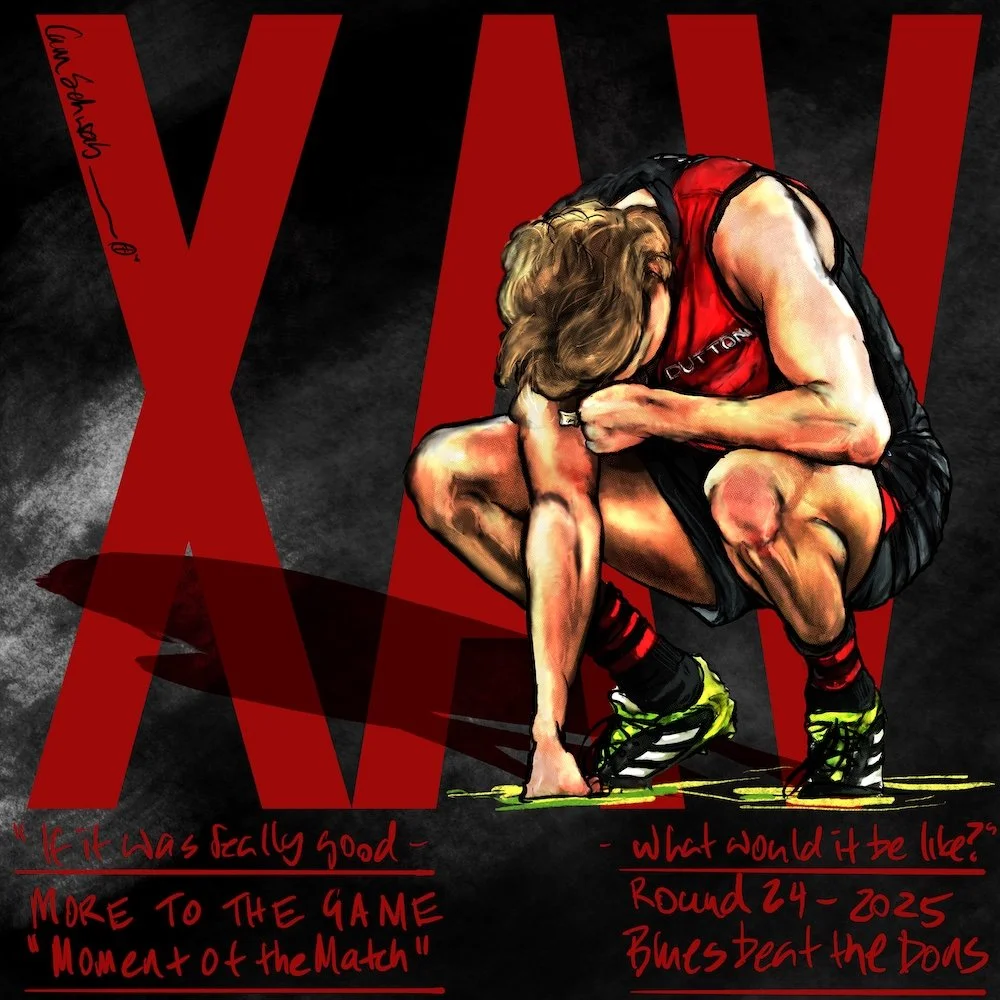
The Bombers
For the Essendon leaders, it will be a mix of deep reflection and bold imagination, built on what is real, the simple truths, with a compelling story to ignite, motivate and bond individuals into one team and one club through the shared future and journey they will undertake together.
The siren has rung.
Another game has been lost.
Essendon were never in it against Carlton, their arch-rival.
While every game of AFL football is high-stakes, it was never going to match the folklore or nostalgia of games of yore, and there was little effort to promote it as such.
Carlton were able to take some solace from their own disappointing season, where performance never met elevated expectations.
It is always good to win the last game of the season.
For the Bombers, that makes it 16 losses for the year, and it will be 17 in a few days with a loss to Gold Coast in the postponed match, making it 13 on the trot.
That’s 90 days without a win.
A very long and mostly joyless season, with all of its recriminations.
But really, they never had a chance. The only momentum the Bombers experienced in 2025 was their injury list.
In the end, 44 players were used, including a record fifteen debutants. The most in AFL history outside of an expansion club.
Some green shoots perhaps.
______________________________________________
In the shadows of our success lie the seeds of failure.
For the famous Essendon Football Club, the losses are felt intensely and broadly.
Football clubs demand our love. It is generational and foundational, and love is the most vexing emotion and the very reason we are so drawn to it and keep coming back for more.
It is who we are.
For Bomber supporters, it has been a couple of decades of disappointment that no one saw coming, layered with intense controversy.
They are a famous club, one of the ‘Big 4’.
They were big, intimidating, and at one point, seemingly unbeatable.
They have learned the timeless lesson, one that I first heard from one of their favourite sons, Neale Daniher:
“The game does not give up its rewards easily”.
______
I have long learned that leadership (and the game) promises many wonderful things, but at no time does it promise to be fair.
We cannot change what has happened, only our response, and this will also be judged, and anything less than some form of action that meets the emotional state of our tribe will most likely be deemed insufficient.
But leadership is never binary, and we must resist this urge. It is nuanced and needs to match the ambiguity and complexity the situation asks of you.
The expectation will be for a response that reflects their anger, a call for action.
When the losses start to add up, everything seems wrong. What was invisible when we're winning becomes the subject of scrutiny and presents the opportunity for individuals to insert themselves into the conversation, only adding to what Australian cricket Captain Pat Cummins describes wonderfully as the “four-horsemen of poor performance - stress, anger, clutter and chaos”.
These individuals, often inner-sanctum types who have the ear of someone close to the club, well-meaning and informed, at least by their own interpretation, often coalesce under the banner of blame.
I have learned that blame finds friends easily but offers nothing by way of solution, and as a leader, you cannot join this chorus, as irresistible as its Siren’s call is.
As the losses mount, the four horsemen will ride over the hill. “You need to change the colour of the cordial”, they say, then ride off, safe in the knowledge that the game will again present the opportunity to ride back over the hill.
To blame is human nature, it attracts a crowd, but offers no future and therefore no solution.
As leaders, we need to be better than this.
Much better.
Better than human nature.
The role demands we hold steady while navigating uncertainty, even when that uncertainty demands personal reflection to self-assess what we are bringing as leader, which mostly sits hidden inside you and will require you to build an internal game strong enough to hold these contradictions, knowing we're only ever experienced, and therefore measured, by how we show up, amplified in times like these.
Rational and informed questioning of self isn't weakness, but a natural and essential response to leadership's inherent ambiguity, the reason we need leadership in the first place.
______
I have followed the careers of the collective Duursmas with a particular interest.
By the end of this year, it is likely that four siblings will be on AFL lists, with Willem being spoken of as the potential first choice in this year's National Draft.
That will make the full W, X, Y and Z of Duursmas, Willem (TBC), Xavier (Essendon), Yasmin (Carlton) and Zane (North Melbourne).
Extraordinary.
My interest also stems from some shared history. I recruited a couple of Duursmas to the Melbourne Football Club many years ago when I was Recruiting Manager of the Demons, brothers Jamie and Dean.
Dean, the father of the current batch, made the senior list and played reserves at Melbourne, but struggled with injuries. He played and coached in country football and is now a school principal in Gippsland.
Older brother Jamie was resurrecting his career after time at Hawthorn, Sydney and Brisbane, and was coming off a knee reconstruction, and we backed our medical and conditioning team to get him healthy enough to fill a need in our team.
A year or so later, Jamie was an integral player for the Demons, including playing Centre Half Back in their 1988 Grand Final after playing the game of his life, curtailing Carlton superstar Stephen Kernahan as the Demons won their way into the Grand Final.
It would again be short-lived for Jamie, as his knee went again a year later, just when it seemed his luck had changed.
All of this comes to mind as I watch the oldest of the siblings, Xavier, battling away for his team, and a head down moment captured when the final siren sounded.
The game, indeed, does not give up its rewards easily.
Something the Duursma family well understand.
______
Do people understand what we are trying to do, and how their contribution matters?
A simple and powerful framing for leaders.
It starts with two expectations for leaders, not as a once-off, but as a deep form of individual and collective commitment:
Define reality
Give hope
The scoreboard might speak one 'truth', but leadership demands we speak two:
Together, this is where we are (reality defined), and
Together, this is where we can go (hope given).
Defining reality doesn’t diminish hope. It gives hope substance.
For the Essendon leaders, it will be a mix of deep reflection and bold imagination, built on what is real, the simple truths, with a compelling story to ignite, motivate and bond individuals into one team and one club through the shared future and journey they will undertake together.
“Make no small plans; they lack the power to stir people’s souls.”
There can be no small plans for Essendon.
It is a great footy club.
_______
The Essendon ‘us’ story
The ‘us’ story is the bridge between the story ‘so far’ and the story ‘not yet’.
Unique, intentional and purposeful, vision-driven and values-based.
A narrative that builds on where you’ve come from and paints a word picture of where you’re going.
Pete Carroll, legendary NFL coach, would ask his team this question each year:
“If it was really good… what would it be like?”
What would it be like for Essendon?
Is it compelling?
Does it move you?
It will not be accidental, nor will it be easy, and it can’t be left to chance.
Wayne Smith, coach of the New Zealand All Blacks, says:
“Creating a champion team is a spiritual challenge.”
The most important thing we can say to any of our people is: “You belong here.”
You are an Essendon person.
It will start with an understanding, from the colour, richness and learnings of their ‘so far’ story, and from the possibility and hope of the ‘not yet’ story.
It could start with something that touches on the ‘so far’ story:
From the McCrackens, father and son, and our paddock from which we played.
The trio of Crichton, Cookson and Reynolds, who shaped a club and on whose shoulders we still stand.
We are the club of Coleman, so fleeting, a reason alone to come to Windy Hill.
Some say there has been no better Bomber than Hutchison, with ample evidence to back this claim.
Coleman then coached, and silverware appeared as if by fate.
Then it was over to Sheedy, a Bomber by birth, who found his way home, and Premierships followed.
Legends grew. Madden, Watson and Hird, and what about those Danihers?
The Same Olds were leaders again, and this is when Essendon is at its best.
When it leads. When it builds on character. When it is fierce.
To always be better.
Much better.
To be the best.
The role expects it of us.
We must honour it.
If it is undefined, it is effectively unknown and therefore untapped.
Essendon is untapped.
______
We cannot outperform our leadership.
A philosophy for leaders.
Not a vision, mission or strategy.
A philosophy that recognises when leadership improves, everybody improves.
It is a leadership practice, a system and structure combined with the discipline to execute when it gets tough, as it will, when your principles are questioned, your craft feels inadequate, and you question who you are as a leader.
It is a leadership mindset (principles), skillset (craft) and identity (trademark).
It is a leadership system of operation that is equal to the challenge of leadership.
Our leaders as cultural and strategic architects.
We draw the rough sketch of a future vision, something that inspires, fully intertwined and connected.
We then allow our people to colour in the rough image we have sketched out, making even more space, knowing we are a better organisation with deeper connections when individuals bring their whole person to create nuance and develop a culture and plan unique to us.
We also understand that no matter how good our culture and strategy seem at any time, all solutions are temporary.
This way, our people will understand what we are trying to do, and how their contribution matters, and what that now expects of them.
Our leaders as condition creators.
This is what the role expects of us - to create the conditions that enable this group, with all its idiosyncrasies, to be the best it can be.
It will be special to be on our team, because it is hard to be on our team. It will not be for everybody. A lot of people will not make it, but they will be given every opportunity.
We are defined by what we tolerate, and it is not personal.
Not everyone will agree with what we do and how we do it, and some may even refuse to buy in.
It might not be for them. That’s ok, but in the end, choices will be made. You are either in or out; there is no space in between.
Our leaders as makers.
We are makers of sense, meaning and belonging, building belief in the face of uncertainty, complexity and ambiguity, knowing that if not for these three interlopers, we do not need leadership.
They are the opportunity. Welcome them.
Our leaders show up.
We drive and model expectations and standards, playing our roles with certitude by making space for each other, building confidence as they grow, often from the learnings that come our way, whether we are looking for them or not.
We understand people do not experience our intentions. They experience our behaviour.
We will not need to go looking for adversity. It will find us. An opportunity to grow. Test our leadership.
Mistakes will be made. By owning them, we grow, and by sharing them, others do as well. By carving our learnings into the wall, those who are not in the room also learn. We become the shoulders on which future leaders stand.
Our leaders hold their nerve.
Character is more than having principles. It is the capacity to live by our principles in the moments that matter.
We do so by being:
calm
brave
humble
compassionate
It may well get messy before it gets better.
Our leaders act and communicate with conviction.
But we also pause, picking up signals and adapting quickly, not letting momentum, external forces and emotion make our decisions for us.
Yes, it will get noisy, sometimes deafening.
That is what it means to be ‘In the arena’.
Our leaders are patient with results, but not behaviours.
We set expectations and deliver consistently, putting together great teams who raise the bar even higher, never shying away from conflict.
We understand that culture is simply an iteration of our collective behaviours.
The best cultures are ‘good at conflict’, and as coaching legend Ric Charlesworth says:
“They go in search of friction, otherwise it appears at the worst possible time”.
There is a simple expectation — stay above the line. And if we are uncertain where that line is, we talk about it without personal judgement.
Our clarity will come from connection.
Our leaders value skill over talent.
The understanding that skill, as we define it, is the full and complete application of talent within the team context, people who are coachable, competitive and connectors.
People who are:
Coachable - Take responsibility for their career, often accepting roles that differ from their preferences, because that is what the team asks of them.
Competitive - Have a fierce desire to win, but as importantly, have the capacity to manage the game’s inevitable disappointments, from moment to moment, week to week, year to year, to take lessons into whatever challenge comes next.
Connectors - People who want to be great teammates understand that team isn’t assumed; it’s an outcome achieved through personal connection.
We are all role players: Knowing our role. Accepting our role. Playing our role.
Our leaders understand that it's all on you, but it’s never about you.
Accepting full responsibility for leadership, but never making it about you, even though it often feels like it is about you.
Our leaders play their moments.
Leadership isn’t about being ready.
You’re never ready.
It’s about being present to what each moment asks of you.
In the moments that matter, we play our moments.
Our leaders have fun.
There is so much joy to be had in football and in our club.
We take the role seriously but don’t take ourselves too seriously.
Our leaders know there is a cost of leadership.
Leadership is hard.
You will be required to make decisions about people you genuinely care about that will negatively affect their lives and will forever impact your relationship.
You will be disliked.
You will be judged, often unfairly, and never be given the opportunity to fully explain yourself.
Our leaders know that leadership is not a got-to thing. It’s a get-to thing.
While the scoreboard will always speak its simple 'truth', leadership lives in a more complex space.
The siren sounding and the game now over simply reveals the next game, another challenge, another moment that demands we find more in and of ourselves.
This is what it asks of us.
Our leaders understand there will be trade-offs.
All great strategy must do two things:
build from a compelling story, and
make the best use of scarce resources.
Making the best use of scarce resources will require trade-offs.
These will be nuanced, ambiguous, and complex, and that is the very reason we need leadership.
What stands in your way must become your new way.
The one thing we will not trade off is our agreed standards and expectations.
Our leaders go deep to go forward.
We understand that discomfort marks the place where the old way meets the new way.
It is a place of vulnerability and courage.
It takes curiosity to learn, courage to unlearn.
If it doesn’t challenge you, it will not change you.
The strongest steel is forged in the hottest furnace.
Our leaders are teachers, not tellers.
We build the child for the path, not the path for the child.
Our leaders have the capacity to unlock performance from both the individual and the team, often by recognising capability and opportunity they are yet to see in themselves, and then by providing a pathway to achieve it.
Get all of this right, and the score will take care of itself.
For the Bombers, a mighty club, there has never been a better opportunity for leaders to lead than now.
Play on!

My work builds on the belief that leadership is the defining characteristic of every great organisation or team.
You cannot outperform your leadership.
Our offering is designed for leaders who know that personal leadership effectiveness drives team and organisational performance and that there must be a better, more efficient and effective way to learn leadership.
Feel free to connect, or make contact