Round #02 - Making the thing
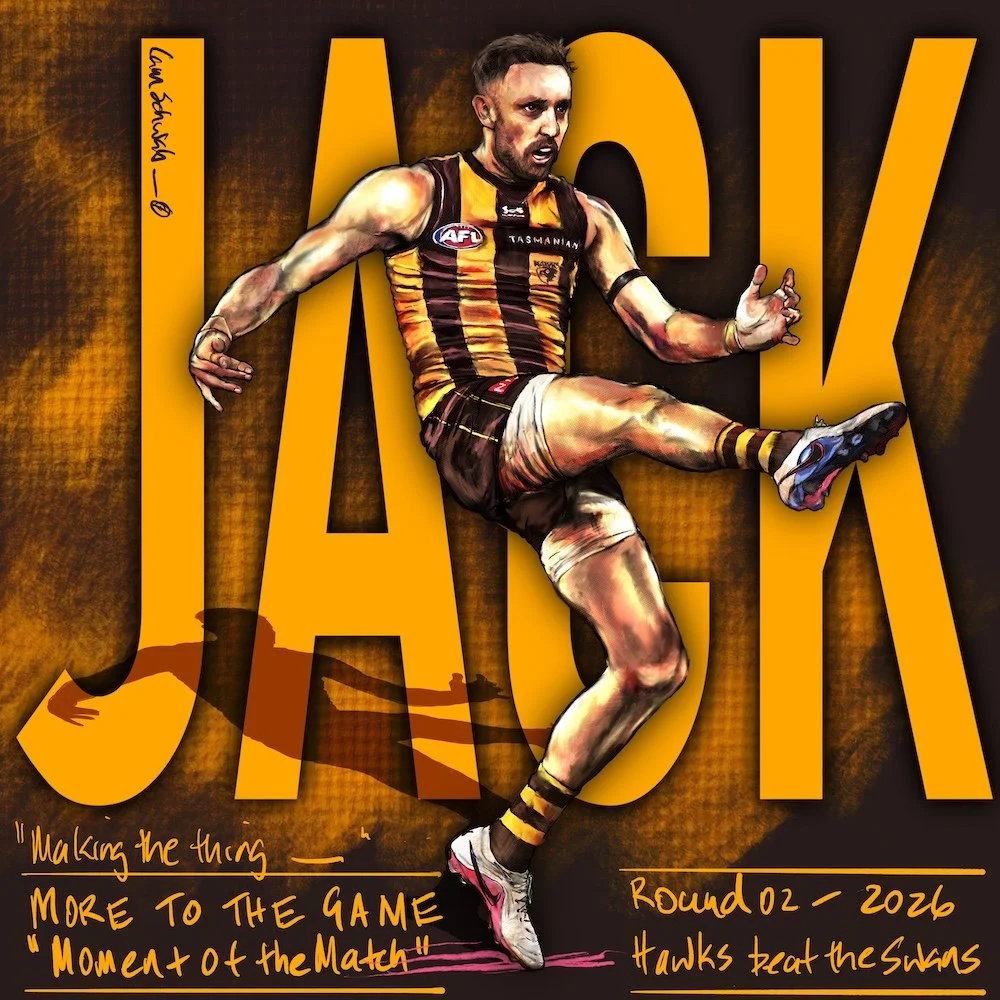
It was a no-promises decision made by Sam Mitchell and the Hawks’ list management team, charged with this delicate balance and its many trade-offs. Sam Mitchell knew Jack Gunston in the most important of ways. He knew what he would bring. He knew he would help ‘make the thing’.
He knew his role, accepted his role, and committed to playing his role.
“Making the thing that none of us can make on our own” - Paul Kelly
I recently read this quote, and it might just be the best definition of team I’ve heard.
It was quoted in a piece written by Greg Baum, who wrote sport for the Age newspaper for many years. He was, and remains, my favourite writer on sport.
He is someone who saw the game and the rhythms and dynamics that ruminate within it.
When I was in the midst of CEOing an AFL club some time ago, and struggling with what it was asking of me, knowing it was the very thing that attracted me to the role in the first place, he coincidentally wrote:
“In season, a football club exists in a state of nervous tension, a 24-hours-a-day dwelling on the next match, relieved only in the two hours of playing it. It means that for all their outward robustness, they are also moody and delicate places, susceptible as a barometer to the pressures that surround them.”
It reminded me of a quote from the poet David Whyte, another favourite, who wrote:
“A true vocation calls us out beyond ourselves; breaks our heart in the process and then humbles, simplifies and enlightens us about the hidden, core nature of the work that enticed us in the first place.”
____
Three weeks into the season, still in the month of March, the game is humbling, and hearts are breaking, with leaders having to rise to what the game is asking of them, understanding this is what they signed up for.
They knew, and are now being reminded, that the game promises many things, but at no point does it promise to be fair.
The nervous tension is playing out in its many forms. The possibilities of a few, whose early-season form suggests they might be in the Premiership mix, but would never mutter those words. At the other end of the hope spectrum, after just 2 games and with 21 games to go, a coach described his team as “demoralised”. Different states, and different moods, but equally susceptible to the pressures that are surrounding them.
Baumy has now retired from this week-by-week reflection and contemplations on the footy. The game misses his nuance, too often getting lost in its own raucousness, a cacophony of experts all talking over each other, relieved only by the playing of it, where we can sit and watch, and make our own minds up on what we are seeing, and even then, we are being told what we are witnessing by the many voices that fill every space possible.
The article where I saw the “making the thing” quote was on the Cricket et al website, and Baumy was reflecting on a suburban cricket premiership reunion for a team he played for 40 years ago, as did one of my oldest and dearest friends, David Wehl, who had sent me a link.
He wrote:
“The sense of shared achievement, at however modest level, remains indelible. It’s the joy of team sport, “making the thing that none of us can make on our own”, as Paul Kelly once wrote. It’s the human condition.”
The Paul Kelly he references is not the former Sydney Swans Brownlow Medallist, but the musical bard. I have little context for the quote, but my assumption is that it refers to the bands Paul Kelly has played in, and that the collaborative aspect of the creative process and making music is its inspiration. But I also know he loves his footy, and still has a kick with his mates at the Peanut Oval in St Kilda, and I would be confident this would also be context.
As leaders, we get to make ‘the thing’. What ‘the thing’ is, well, that is up to us to give definition, something so compelling that we willingly give up some part of us for the benefit of a collective endeavour, a belief in something bigger than any one of us.
What I have learned, often the hard way, is that a group of people all wearing the same colours doesn’t make a team, particularly one that can withstand the rigours that connected teams are required to experience, to deepen the connection when the going gets tough, as it will.
I think it is helpful to think of ‘team’ as an outcome, and the first part of making when ‘making the thing’ is the team itself, measured by the behaviours, individually and collectively, that our shared purpose and identity demand.
____
I love the insights of famous music producer Rick Rubin, who has worked with everyone from the Beastie Boys and Johnny Cash to the Red Hot Chili Peppers, Metallica and Adele.
The collaborative process, as it relates to creativity and performance, the importance of disagreement and challenging our thinking, and each other, in order to get the best outcome.
“Most people in collaborations want their idea to win, but that’s not a good collaboration. It doesn’t matter at all. All that matters is that the final result is the best thing it can be”, he writes.
My interpretation of Rick Rubin’s insight:
It isn’t about ‘your’ idea, it is about ‘best’ idea, but we need to hear ‘your’ idea to get the ‘best’ idea. We need to hear you argue for ‘your’ idea, and we will often disagree as others argue for their idea, and sometimes it will feel personal, because it is and needs to be, and always will be. This is what it means to be in a team. At the end of this process, we will land on a ‘best’ idea, and even if you do not agree, we go forward committed to its execution and your role in it, because it is not about agreement, it is about alignment.
This is what it means to be in a team.
To know your role, to accept your role, to play your role.
To ‘make the thing’.
The thing that none of us can make alone. That is the promise of the team.
____
Hawthorn forward Jack Gunston’s season has picked up where his unlikeliest of seasons in 2025 left off, and his Hawks are in the mix and remain reliant on contribution despite his veteran status.
He kicked 4 goals 4 behinds in the Hawks’ win against the undefeated Swans in Round 2 at the MCG, including two in the last quarter when the game was there to be won.
All of his canny forward craft was on display, the art and the science.
He has become one of football’s great stories, and with plenty still to be written.
He was a wonderful contributor in Hawthorn’s three-peat of Premierships.
In 2023, a well-intentioned but ultimately unsuccessful season at Brisbane that didn’t go as planned, with a back injury that required surgery, threatened to end it all, and appeared to have done so.
Eyebrows were raised when he was traded back to Hawthorn at age 32, a decision that seemed incongruous with the youth-focused direction of the club under new coach and Jack’s premiership teammate, Sam Mitchell.
He was described, despite his achievements, as a ‘list-clogger’. It was suggested that the team should be making space for players over a dozen years his junior.
It was a no-promises decision made by Sam Mitchell and the Hawks’ list management team, charged with this delicate balance and its many trade-offs. Sam Mitchell knew Jack in the most important of ways. He knew what he would bring. He knew he would help ‘make the thing’.
He knew his role, accepted his role, and committed to playing his role.
The club wasn’t sure how much football he had left in him either. As a player, despite his 242 games and three premierships and a Peter Crimmins Medal best and fairest award, his contribution was unknown, and in many ways unknowable. Both player and club understood it could be minimal. What the club knew was his human characteristics, a willingness to pass on his incredible forward craft, and the lessons of a footy career fully lived.
Play he might, but mentor he would. He came back to help the young Hawk forwards find their way in this most complex of trades, the master and his apprentices. To be a guide from inside the boundary, an on-field presence. If that meant not playing much senior football, he was prepared for that.
Before the 2025 season, his second year back at the club, Jack decided to train as hard as he possibly could and let his back decide. No managing himself. No hedging. All in.
The back held up. He had an exceptional pre-season. And then he wasn’t selected for the first two games, came back through the sub’s vest in week three of the Hawthorn season, came on the ground, kicked a couple of goals, and never looked back.
By the end of the year, he had kicked a career-high 73 goals and was second in the Coleman Medal, earned his second All-Australian blazer, won his second Peter Crimmins Medal, and was voted by his peers as the winner of the club’s Lethal Award. The best season of his career. At 33.
But the goals are not the story. The story is the decision that made them possible. And the humility that preceded it.
____
Young Hawthorn forward Calsher Dear was 16 when his father Paul died of pancreatic cancer in 2022.
Paul Dear was a 1991 premiership Hawk and Norm Smith Medallist. This year Calsher is wearing his father’s number 13.
Jack Gunston was 30 when he suddenly lost his father, Ray. He wears a black armband every game in his honour.
I was 29 when I lost my father, Alan, also suddenly. I know this loss. Over more than 30 years, I have sat with others who carry it. It does not leave you. It changes shape, but it does not leave.
I felt it when I heard that Ray had died. I knew him, calm, bright and generous, someone who would help you draw the outline of a future unknown, and allow you to colour it in. He was someone the game turned to when it needed someone to fill the places only men like Ray could fill, including stepping in as Essendon FC Interim CEO in the midst of their supplements saga.
When watching Jack play, I think of Ray, and I think of Dad.
Ray went to all of Jack’s games. Only at the football, when watching his son play, did the calm desert him. Ray paced the stadium concourse throughout every game. Too nervous to watch, too devoted to leave.
I think of Jack and Calsher working together. Two young men shaped by loss, finding each other in a forward line. Jack knowing what Calsher carries. His on and off-field coaching of the young football tyro has been equally important to the goals, if far less visible. Hawthorn need Calsher to be everything he can be. Jack has committed himself to making that happen. A playing assistant coach, still in boots, still earning his place, still ‘making the thing’.
The goals are the evidence. The choice is the story.
____
I again refer to Baumy’s take:
“This is the beauty of a premiership reunion. Some of what we have all become has its roots in that sepia-toned triumph. Before and after meld, then and now become one. I could see and hear in the wondrous faces and voices of us now old-ish men the boys we once were, and in turn see and hear the boys projecting into a still unmapped future, but knowing one thing for certain, that it would always have a premiership in it. We’re proud of what they did then, but I think they would be proud of who we are now.
For a moment, we stalled Kierkegaard’s famous axiom about how life can only be understood backwards, but must be lived forward. We lived backwards and forwards at the same time."
Jack’s career will always have Premierships in it, as did Paul Dear’s. I am sure there is room for one more for Jack, and it might just have Calsher Dear sharing the forward line.

My work builds on the belief that leadership is the defining characteristic of every great organisation or team.
You cannot outperform your leadership.
Our offering is designed for leaders who know that personal leadership effectiveness drives team and organisational performance and that there must be a better, more efficient and effective way to learn leadership.
Feel free to connect, or make contact