Round #04 - Just be a good person
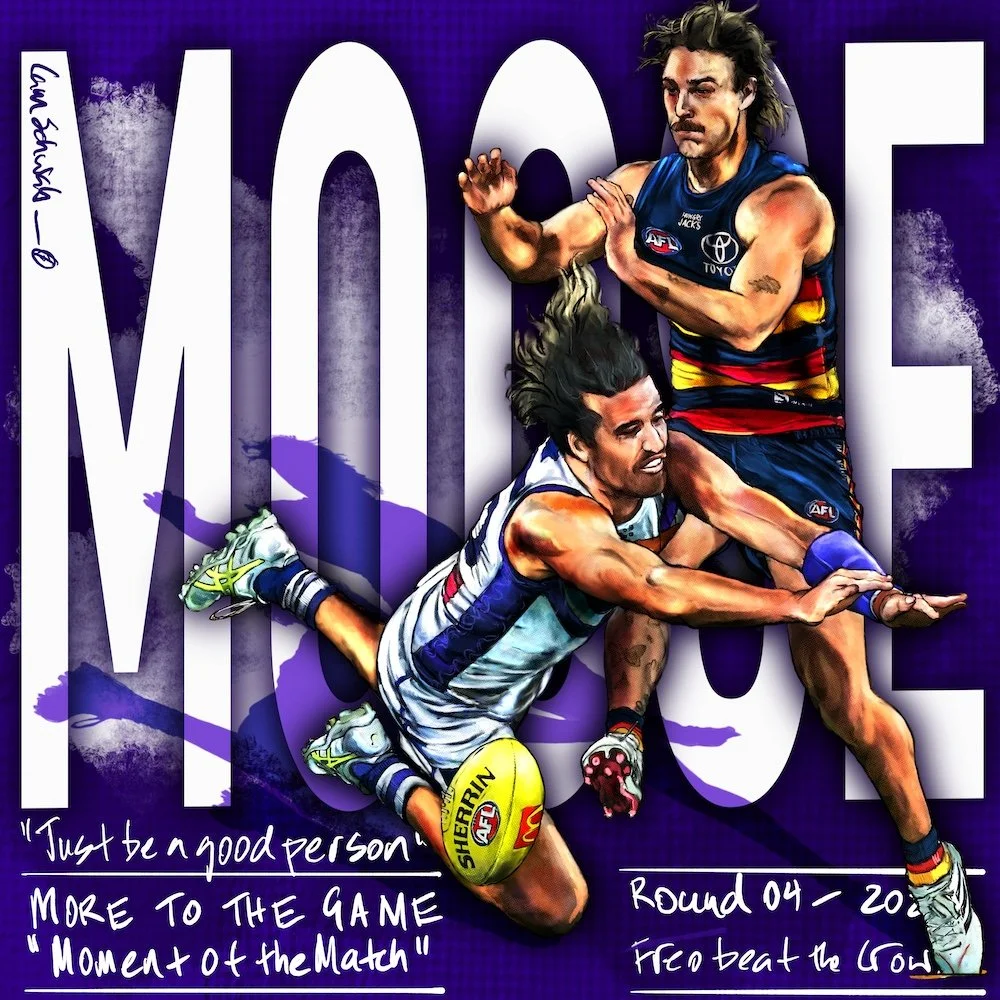
In the dying seconds, Adelaide's James Peatling shaped to kick for goal. From nowhere, Alex Pearce came diving across, sans cape but superhero in every other way, full stretch, arms out, no concern for his personal welfare, and smothered the ball.
My first day.
My first as the newly appointed CEO of the Richmond Football Club.
I am 24 years of age. So much is familiar, yet everything is different.
I know this room, the CEO's office, although it seems smaller than I remember it. I sit in the CEO's chair behind an old veneer desk. "This old boy could tell some stories," I thought.
The office sits under the century-old Jack Dyer Grandstand at the Punt Road Oval, Richmond. The room is adjacent to a boardroom. On the boardroom table lies a weathered and storied tiger skin.
Welcome to Tigerland.
____
I was last in this office a dozen or so years ago, sitting on the other side of the desk. A visitor, but privileged, for the man who is sitting in the chair I now occupy was my father, Alan, and from here, he ran the Richmond Football Club. They were called Secretaries then.
I had no lack of visitors on my first day. Familiar 'inner-sanctum' faces, some I remembered from my childhood, would appear in the office doorway. They didn't wait for an invitation to enter; they presumed, closing the door behind them, seating themselves in the same visitor's chair I sat in as a boy.
They arrived under the guise of good wishes, talked about my Dad, what great mates they were, the many Premierships won, and, with a wink, “…and didn’t we have some fun!”
But mostly they came with an agenda of some form. They would explain where it had all gone wrong for the club, as it undoubtedly had, never speaking of their role, and always building a platform for the advice that was soon to come my way.
They'd glance back towards the doorway, sometimes standing up to check it was fully closed, even going as far as to snib the lock before resuming their seat. Leaning forward and encouraging me to do likewise, they would take a deep breath, exhale theatrically, and speaking with a loud whisper, say something like:
"If I was sitting in your chair, the first thing I would do is get rid of (insert name of coach, player, president, director, doctor, trainer, bootstudder) they're the fucking problem…." and "whatever you do, don't let that prick (insert name of former coach, player, president, director, doctor, trainer, bootstudder) back in the joint. He is a cancer."
And with a handshake, another wink and a "Go Tigers! Eat 'em alive!" they would leave.
____
“Ruthless Richmond”, the commentators would say, and it was a brave person who got between the Tigers and a victory, be it on or off the field.
But there is no lack of courageous individuals in elite sport, people who soon found ways of matching the Tigers' daring and work ethos, but also uncovered new ways of doing things, more sophisticated, more strategic, and before long, more successful.
Richmond held onto its old ways. The 'Ruthless Richmond' mindset often turned inwards, and good people were lost, sacked or squeezed out, including legendary coach Tom Hafey, and my father a decade earlier.
The advice from my visitors that day harked back to the old ways, but there was no hiding the parlous state the club was in. Last on the ladder, broke and broken, facts seemingly lost in these conversations, which were high on entitlement and blame, but low on accountability and responsibility.
There was a subtext to every conversation. As CEO of Richmond, this is how I was expected to behave.
To be ruthless.
To be brutal.
To be cruel.
To be a prick.
____
As a leader, people do not experience our intentions; they experience our behaviours. And the behaviours prescribed to me on that first day had nothing to do with the kind of person I wanted to be.
I just didn’t know that yet.
I now understand, in roles of this nature and consequence, the world will continually ask, “Who are you?” And if you don't know the answer, it will define you for you, but not by you.
On this day, the first serious leadership role of my life, the world was defining it for me.
Not once, in all of those visits, all of that whispered wisdom, did anyone say the simplest, most useful and helpful thing, and the first thing I say to first-time leaders, not as advice given, as that would be presumptuous, but as an idea shared:
“Just be a good person”.
____
My inspiration to be an artist started with DC Comics. Batman. Superman. Then the footballers became my superheroes, and in many ways, still are.
Fremantle captain Alex Pearce could have appeared in those comic books. Perhaps as a long-lost cousin of Aquaman. The hair. The beard. The jaw. The height. The build. The total superhero archetype.
If central casting needed a skipper, they'd send for Alex Pearce.
And central casting made the call. On Good Friday. Adelaide Oval. Fremantle v Adelaide.
Freo led by 34 points midway through the third quarter. They were controlling the game in the way good teams do — a good mix of all the important stuff that wins games in 2026. And then Adelaide came. Seven goals either side of three-quarter time, with all the momentum in their favour. The team had lifted, and so did their 19th Man, the Crows supporters creating their ‘wall of sound’, one of the most intimidating experiences in football, particularly when you are so far from home.
The game had turned completely, and soon the Crows led.
In the dying seconds, Adelaide's James Peatling shaped to kick for goal. From nowhere, Alex Pearce came diving across, sans cape but superhero in every other way, full stretch, arms out, no concern for his personal welfare, and smothered the ball, as my drawing celebrates.
The siren sounded. Fremantle by two points.
His teammates mobbed him. His coach, Justin Longmuir, said afterwards: "It's a super smother. He's a competitor, and that's why we love him as our captain."
Our heroes are human. That's what makes them heroic.
____
I don't know Alex Pearce personally. But I am a very conscientious observer of Fremantle. I spent eight years there as CEO during a time of significant transition for the club. I felt fully vested then, and still feel it in my soul all these years later.
Alex Pearce is loved. By his teammates, his coaches, the Freo people, and, increasingly, the football community in a way that transcends club loyalty. He is a terrific player, no doubt. Justin Longmuir would confidently put his magnet against the opposition's best tall forward every week. But Pearce has never finished in the top three of Fremantle's Doig Medal. He has never made an All-Australian squad.
The esteem he is held in has nothing to do with accolades. It has everything to do with who he is.
____
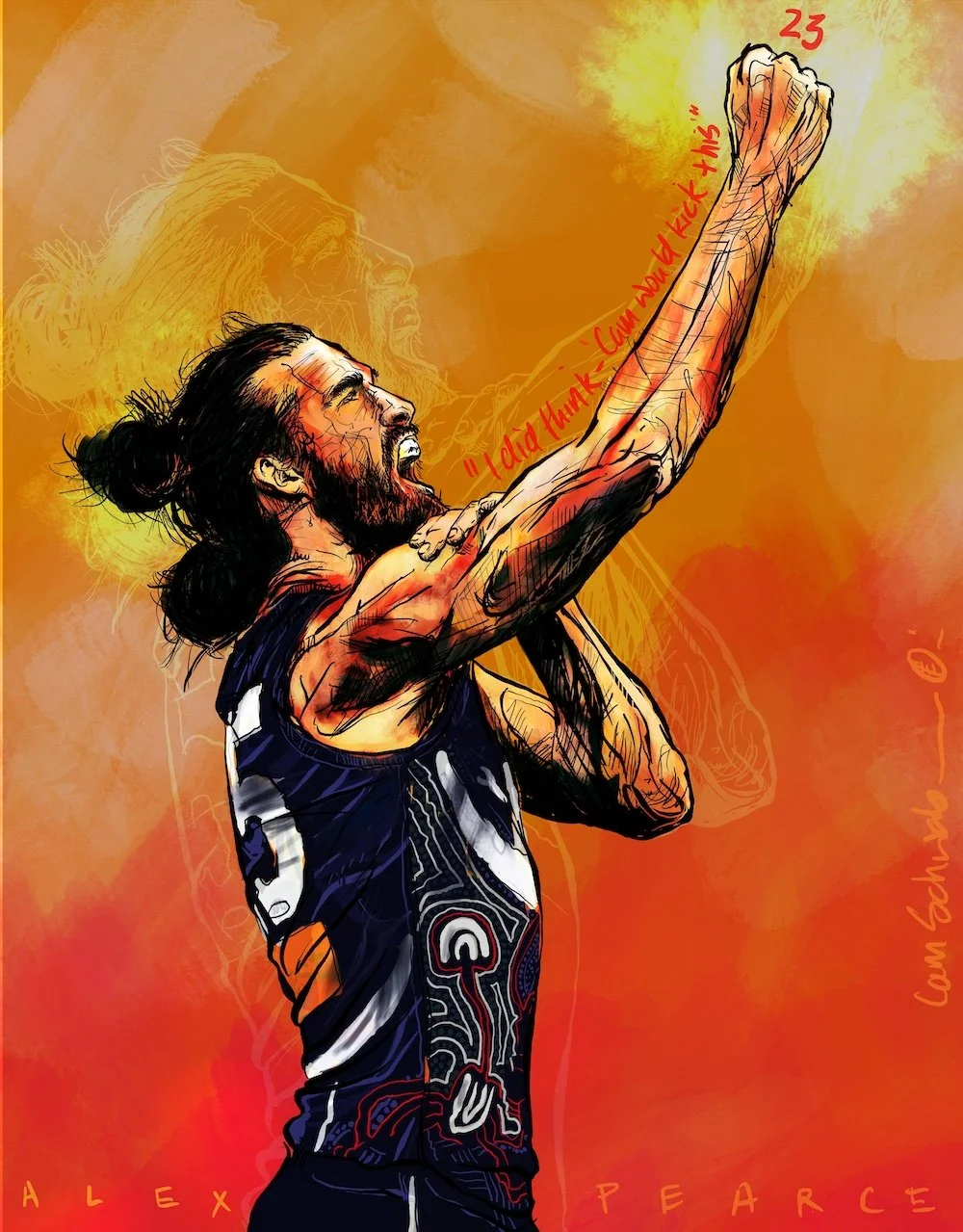
It is not the first time I have drawn Alex Pearce in a superhero pose.
In May 2024, his former teammate and great friend Cam McCarthy died. He was just 29, and Alex Pearce led his team onto the field that day. After the game, he and Nat Fyfe laid purple flowers in the goalsquare where Cam McCarthy played.
The following week, Pearce, a key defender with only five career goals to his name, slotted one to draw the game against Collingwood, and his fist went to the sky.
"I did think Cam would kick this," he said afterwards.
____
Character is more than just having principles. It's our learned capacity to live by our principles.
Legendary NFL coach Pete Carroll talks about "a relentless effort to get clear on what is important to you, what uncompromising principles do you stand by, what makes you who you are."
If you don't go through that process of self-discovery, you don't have an opportunity to be your best, because you do not know who you are yet. When you're still forming as a person, let alone forming as a leader, you are more likely to fulfil an external expectation than find your own.
Alex Pearce has said of his own leadership and typical humility: "I always wanted to be authentic and not be anyone else. It just took me a little bit of time to be able to trust myself."
Leadership demands authenticity, and it is best to think of authenticity as an outcome. There is no authenticity without vulnerability, and there is no vulnerability without bravery.
As David Whyte wrote, "Vulnerability is not a weakness, a passing indisposition, or something we can arrange to do without. Vulnerability is the underlying, ever-present and abiding undercurrent of our natural state."
Alex Pearce didn't arrive at authenticity by announcing it. He arrived at it by living it. In the way he honoured his mate. In the way he threw his body across a football on Good Friday, in the way he shows up for what leadership asks of him.
He is a good person.
____
If I were to have a conversation with the young bloke in the Tigers’ CEO chair all those years ago, I would pass on Pete Carroll's timeless wisdom, then explain my take:
“You can't trust your feelings, but you can learn to trust your principles. And if ever you are in doubt, draw it back to one, and only one:
“Just be a good person”.
Play on!

My work builds on the belief that leadership is the defining characteristic of every great organisation or team.
You cannot outperform your leadership.
Our offering is designed for leaders who know that personal leadership effectiveness drives team and organisational performance and that there must be a better, more efficient and effective way to learn leadership.
Feel free to connect, or make contact