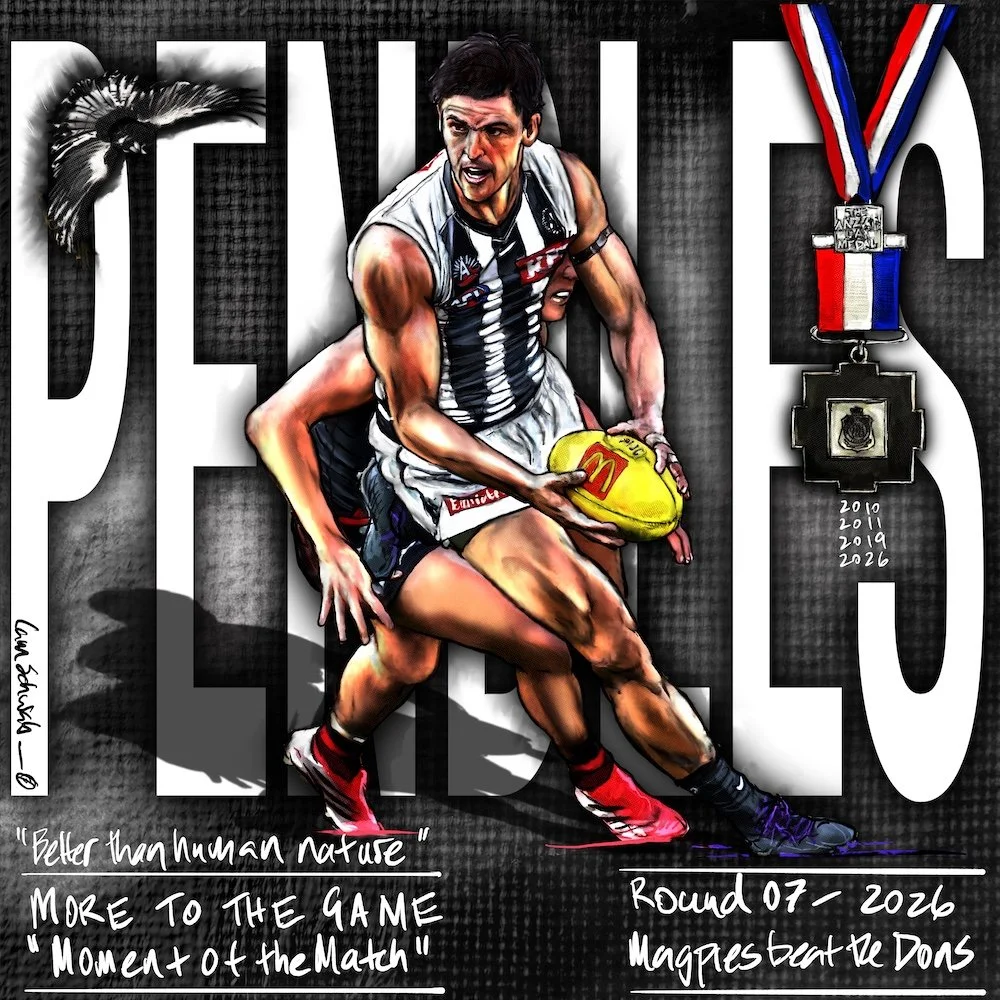
Whilst it is now many decades since I heard Barassi explain how the great players are better than human nature, I continue to find new meaning in it.
Initially, I thought of it as being superhuman, the capacity to withstand the physical and emotional challenges the game and life will throw your way, and there is a lot of truth in this.
This version of Scott Pendlebury’s greatness was on display on Anzac Day.
It was a once-a-month meeting of the Match Committee of the Melbourne Football Club.
It was held away from the usual meeting place, a small, discreet, almost secretive room next to the player changerooms in the bowels of the MCG, where the team then trained. The Match Committee would assemble post-training a few times each week to pick the Melbourne side to take on whichever club we were playing this coming Saturday afternoon.
I was the Assistant to the Football Manager of the club, my first job straight from school, playing what would be best described as a secretarial role to the committee, quietly rejoicing in my fly-on-the-wall access to some of the best football minds in the country, charged with dragging the famous club up by its bootstraps.
The biggest presence was always Ron Barassi, the ‘Super Coach’, who had returned to the club where his legend was born, a playing career that included six Premierships, but none, not even a finals appearance, since he famously crossed to Carlton a couple of decades earlier. More Premierships would follow for Ron, this time as coach. He would win two at the Blues, and later two more at North Melbourne, including their first ever.
This meeting would be held in a back room of the Mountain View Hotel in Richmond, and the expectation was that it would be a long night. Changing the physical setting seemed a metaphor of sorts for a different conversation, not focused on the immediacy of the next game, but on tracking the current state of the team against some future vision that was in the hands of these great football people.
Ron Barassi owned the pub with Adrian ‘Gags’ Gallagher, a former Carlton premiership player and one of our assistant coaches and a sharp football brain and wit.
It was my job to set up the room for this conversation, which included a large board covered in magnets with the names of our current list of players, each one presented in my best handwriting. By the end of the evening, those magnets would have moved through a series of columns, each one the subject of often vigorous and ‘take no prisoners’ debate, ending in a judgement as to whether the player had a role to play in this future vision of the Melbourne Football Club.
“Can anyone see this bloke playing on the last Saturday in September?” was often the standard for judgement, and it would be fair to say that not enough of our current list reached this standard to form the quorum required for this outcome.
We were a long way from it, and no amount of Barassi will, genius or charisma was going to fill that gap.
The Match Committee was made up of powerful football voices. Barry Richardson was Chairman, a former Richmond premiership player and coach, whom I knew from my childhood and who was a good friend of my father, Alan Schwab, who was Secretary of the Tigers during their premiership era. The strongest and most vocal in the room was Ray Jordon, considered the best junior football coach in the country, who also cut his coaching teeth at Richmond. There was also a future AFL coach, Stan Alves, the recently retired former Melbourne captain and North Melbourne premiership player, who was starting his coaching journey. With Gags Gallagher and Barassi, it was a formidable line-up of football acumen, as good as any club could accumulate.
The meetings would start with a pub meal, and as was the way in those days, whatever your drink of choice. Barassi was a Bacardi-and-Coke man, soon to switch to Bundy-and-Coke for patriotic reasons. The discussions were boisterous and frank, and would go deep into the early hours of the morning. I didn't drink much, if anything; my excuse was the fact that I’d be driving home, whatever time the evening finished.
As it turned out, my sobriety and comparative lucidity became a gateway. After the formal discussions, with less structure and hierarchy, I found myself included in conversations that could go in any direction, building on the group's respect and collegiality, in which I was mostly silent but always welcome.
Inevitably, they would talk about the great players and the great teams, drawing on decades of experience and trophy cabinets of silverware as context.
Whether I knew it or not, a question was forming in my mind, one that in many ways, I am still trying to answer:
“What makes the great players great?”
___
I had been chasing this question before I knew it was a question.
As a kid, sitting in front of World of Sport, I watched then Tiger champion Kevin Sheedy win the Handball Championship. Football icons Jack Dyer and Lou Richards described him as "a student of the game."
“That’s what I want to be”, I thought, not because I could see any future in it — that seemed well beyond my reach — but because I could not get enough of the game, and in particular, the Richmond Football Club.
Given my heritage in the game, I never saw myself as someone who would only follow football. I wanted to understand it, and I was already surrounded by the deeper conversations. Why some teams win, and others lose, what separates the players who make it from those who don't, who survive the sport whilst others are cast aside.
By eighteen, I was the Assistant to the Football Manager at the Melbourne Football Club, and whilst I had a formal job description, it was pretty much “Do anything Ron Barassi asks you to do”.
This included setting up the player team meetings at the MCG, which meant carrying the club's only television, a 26-inch Rank Arena, up many flights of stairs, setting up the VCR, and getting the soup ready.
I think it was the best job description I’ve ever had.
I sat in on these team meetings. After a few months, I realised that most of the meeting was taken up by Ron fast-forwarding and rewinding the game tape as he worked his way through a long list of highlights and lowlights from the previous weekend's game, all listed on a foolscap pad. No amount of Barassi persona could hold the attention of 20-something athletes, men who had completed a full day's work followed by a tough training session, through this ordeal.
I nervously approached Ron after one of these sessions with an idea that I might be able to edit his tapes for him. Having mastered the art of the music ‘mix-tape’, a lost art of generations past, I thought I could create a ‘mix-tape’ of Ron’s coaching edits, assuming VCR-to-VCR would operate the same as cassette player-to-cassette player.
Ron gave me his foolscap notes. The next day, I visited Tandy Electronics, bought some cords, and connected the club VCR to the one we had at our family home. In the bedroom I shared with my brother Brendan, I edited a tape, completing the exercise at about 3.30am.
The following day, I took it to Ron, and he put it in the VCR and pressed play. He looked at me like I was a freaky genius, and asked if I could do this every week, and I said yes.
I was now the unofficial ‘Technology Manager’ of the Melbourne Football Club.
I was in daily conversation with Barassi about the game. I was learning to see what Barassi saw, what he was coaching to. What he demanded. What he recognised in a player that others missed.
Every so often, while editing the tapes, I would see something that I thought illustrated what he was trying to coach. We'd discuss it, and after just a few weeks, he said, “If you see something like that, just put it on the tape”.
I'm now sitting in player meetings with my edits being coached by Ron Barassi. Only a few months earlier, I was trying to get a kick for my school football team.
My ten thousand hours in the game were now well underway, having begun years earlier, the day I decided to become a 'student of the game'.
It was at one of those Mountain View meetings that the conversation turned to me.
I remember Barry Richardson and Ray Jordon talking amongst themselves, then bringing Ron in. I could tell they were talking about me. Later in the evening, the discussion became explicit. Barry led it, suggesting I be given a trial — six months to see if I could recruit footballers. Ray spoke of my merits. I think they rated my pedigree as much as the football conversation we’d had, my father, having built a great reputation as a recruiter with a legacy to match.
It all seemed fanciful to me. The recruiters, in my mind, were Yoda-like figures, not the domain of a young bloke barely out of his teens. Then Ron spoke about the ‘mix-tapes’, the initiative, the effort, the conversations we had, the fact that I had opinions and ideas.
Then he said, “I don’t think I have met anyone who loves the game like Cameron does”.
I remember feeling embarrassed about that at the time, almost a need to protest or argue for some dimension of me that he had not yet seen, but soon understood it was a prerequisite for the possibilities he and the others in the room had for me.
I remember Ray Jordon saying to Ray Manley, the Football Manager, whom I was an assistant to the, "Hey, Ray, can we find the young fella some petrol money? He'll be doing some miles.”
As they were describing this, they were painting pictures of me and my future, which, to that point in my life, I had no concept of. They had seen things in me that I had never seen in myself.
I now understand that one’s self-view is limited by many things, mostly the fact that we only bring one imagination to our lives. When others are prepared to do so with generosity, integrity and insight, our world opens up in ways that were to that point unseen, and therefore unknown, and most importantly, untapped.
Until that time, my only career ambition had been to remove the words ‘to the’ from my job title, as the Assistant tothe Football Manager. I would have been extremely satisfied to finish my career as the Assistant Football Manager. In fact, I'd even taken one of my business cards and used liquid paper to white out those two words, keeping it in my wallet as a kind of talisman.
Now these men were asking me to do something I had never imagined. To go out into the world and answer the question we'd been sitting around debating in that pub, not in conversation, but in practice.
“What makes the great players great?”
___
The football world was changing, and some clubs were ahead of the curve.
When Kevin Sheedy went to Essendon as senior coach, he appointed a Richmond administrator, Noel Judkins, as the first full-time recruiting scout. The decision immediately started bearing fruit, and the football world began to notice. Essendon had uncovered some rough diamonds and was becoming a force, with a couple of premierships soon to show for it.
I now wonder whether this was the catalyst for the Mountain View conversation.
Both Sheedy and Judkins were well known to the Richmond contingent. Richmond was famous for its recruiting, both mindset and skillset, led in earlier times by then Secretary Graham Richmond, and later by my father. Their view was that Sheedy and Judkins had taken this Richmond attitude to the Bombers, and it was paying off in a big way.
Maybe I could bring a bit of that to the Demons.
When I went looking for the best recruiting mind I could find, Noel Judkins was the man.
The great recruiters can watch a player and see not what is, but what could be. They recognise the rough outline of something yet to be formed, which, with quality coaching and self-belief, can be coloured in.
Given our shared Richmond heritage, Noel Judkins' father, Stan, was the Tigers’ first Brownlow Medallist. Noel was happy to cross club boundaries and became a wonderful mentor for me.
So what did he look for?
“Players who keep their feet, never fumble, make good decisions and execute, and who never give up, they're the great ones”, he said. “Anything else is a bonus”.
After a few months in the role, armed with Noel’s insights, I took my question to Ron.
“What makes the great players great?”
Ron took out his foolscap pad and started writing down the names of the great players he had played and coached with and against, the biggest names in our game for the previous three decades, looking for the one thing they had in common.
He couldn't find it. Almost with a sense of exasperation, he looked at me and said:
"The great players are better than human nature"
___
All of this comes to mind as I watch 38-year-old Scott Pendlebury collect a career-high 43 possessions and his fourth Anzac Medal in his 431st game, as my drawing celebrates.
I think of Noel Judkins every time I watch him play.
It was twenty-one years ago. Noel, now working alongside Collingwood's newly appointed Recruiting Manager Derek Hine, nominated a 17-year-old basketball convert from the country town of Sale — Scott Pendlebury — with the fifth selection in the National Draft.
At the time, he was described as a ‘draft bolter’, having been expected to go in the second round.
Five years later, he was the Norm Smith Medallist in Collingwood's 2010 Premiership team.
Noel’s words echo.
“Players who keep their feet, never fumble, make good decisions and execute, and who never give up, they're the great ones”, he said. “Anything else is a bonus”.
Gilbert Enoka, the mental skills coach who has worked alongside the All Blacks for over two decades, puts it this way.
"When the pressure is at its highest, champions don't necessarily raise their game — they just deliver brilliant basics."
One of the greatest All Blacks, Dan Carter, describes it as a form of custodianship, the responsibility of carrying something bigger than yourself, not inherited as some kind of birthright but kept, actively, through behaviour — day after day. In the moments that matter and in the moments nobody sees.
___
Whilst it is now many decades since I heard Barassi explain how the great players are better than human nature, I continue to find new meaning in it.
Initially, I thought of it as being superhuman, the capacity to withstand the physical and emotional challenges the game and life will throw your way, and there is a lot of truth in this.
This version of Scott Pendlebury’s greatness was on display on Anzac Day.
The other version was the week before.
Carlton's Talor Byrne missed a goal after the siren that would have won it for the Blues, a defining moment for a young man in only his fourth game.
Talor's teammates sensed this and immediately surrounded him. It was a genuine show of mateship and connection despite the heartbreak of a team so desperate for a win.
Then, through the mass of Carlton Navy Blue, there were the black and white stripes of a Collingwood jumper. It was Scott Pendlebury, who, whilst his teammates celebrated a nail-biting victory against their most famous foe, had a few quiet words with his young opponent.
The Carlton group quietly make room for the Collingwood man, such is their respect.
"He was so shattered, but he put himself in a position to win it, I just said 'keep doing it', and you will nail it. He was the man in the arena just then".
This is Dan Carter’s custodianship.
‘Better than human nature’ is essential to the effort to ‘get-good’ at this level of competition.
But then there is another level that happens when there is nothing left to prove. This is the ‘make-good’ phase. It comes from a place of love, care and generosity.
Better than human nature asks that we climb two mountains. The ‘get-good’ mountain and the hard-won lessons it will ask us to confront and overcome, to not relent, to find something in ourselves, when we have nothing left to give.
To climb this mountain, we need what we describe as a ‘performance ego’: the 'I've got this' mindset, to continually put ourselves in a place of risk, often when self-doubt keeps telling us otherwise. Less obvious for those watching on as we climb this mountain is the ‘quiet ego’, the learner within, who understands that our mistakes are our greatest teachers.
The ‘make-good’ mountain draws its wisdom from these lessons and asks that we offer ourselves up for the benefit of those who might, but also might not, benefit from what we 'pass on', without expectation or anticipation. It is the 'quiet ego' that becomes visible, not as performance, but as presence. The ‘performance ego’ is no longer necessary, so ingrained in our identity that it no longer needs to be shown for people to know it is there.
The transition between mountains is vexed, and many do not make the second journey in football, or life for that matter, let alone whilst still playing the game at the highest level and with such mastery and serenity. Those who don't find their second mountain are trapped in their 'performance ego'. Scott Pendlebury has been climbing this mountain for many years, and it defines our experience of watching him play. For those who find themselves in his orbit, as Talor Byrne did for just a fleeting moment, the impact can be profound.
I was so fortunate to be in Ron Barassi’s orbit as he climbed that second mountain, prepared to bring the best of his imagination into my life, and my life was forever changed.
"The great players are better than human nature"
Play on!

My work builds on the belief that leadership is the defining characteristic of every great organisation or team.
You cannot outperform your leadership.
Our offering is designed for leaders who know that personal leadership effectiveness drives team and organisational performance and that there must be a better, more efficient and effective way to learn leadership.
Feel free to connect, or make contact