Lesson #24 - Define reality. Give hope.
I have a sticky note on my desk that says:
“Build the leadership system that is equal to the challenge of leadership.”
I wrote it many years ago, and the note has followed me ever since.
This idea became central to my approach to building designCEO. Create a leadership system that truly meets the demands of leadership.
I had recently read James Clear's soon-to-be best-seller, 'Atomic Habits' and was inspired by his now-famous quote:
“You do not rise to the level of your goals; you fall to the level of your systems,”
I was immediately aware of the paradox, the ‘irony of one’s expertise’. As a CEO in the AFL, where the goals are mostly obvious, leaders in the game unapologetically focus on ‘the system’.
For decades, I prioritised ‘system setting’ over ‘goal setting’.
It was time to build the system I wished I’d had.
The following practice now sits at the heart of it.
—
As leaders, we are makers.
We are makers of place (creating belief & belonging) and makers of meaning (setting direction & embedding purpose), but there are so many layers to this, which means leaders must also be makers of sense (confronting ambiguity & complexity).
If, however, we do not become makers of space (a practice of reflection & responsive decision-making), we will be in a constant state of overwhelm, as so many are. Whilst it might seem unkind to describe it as such, in many ways, it is dishonouring the role.
The danger of the work I do with leaders is that it is reduced to a kind of ‘project’, with distinct timelines and expectations. But leadership is a practice, not a project. The most important practice is reflection, ensuring awareness of your role and its demands, guided by this key principle:
"Define reality. Give hope."
—
I often hear club supporters bemoan the use of the word ‘system’ in almost every media interview with players and coaches. I would, however, suggest that leaders take more than a few leaves from this book.
It may sound clichéd in its delivery, but the reasons are clear.
Inside a club, everyone knows the game is not club vs club or even team vs team, as it is judged from the outside. It is system vs system.
It is our system vs your system, and in the long run, the clubs/teams with the best systems, whilst never guaranteed, give themselves the best chance of winning.
And there are hundreds of evolving, interdependent systems. Mistakes are inevitable, but learnings are gathered, questions are asked, analysed and assessed, from which decisions are made, a process, which is a system in itself, a system that embeds a practice of reflection.
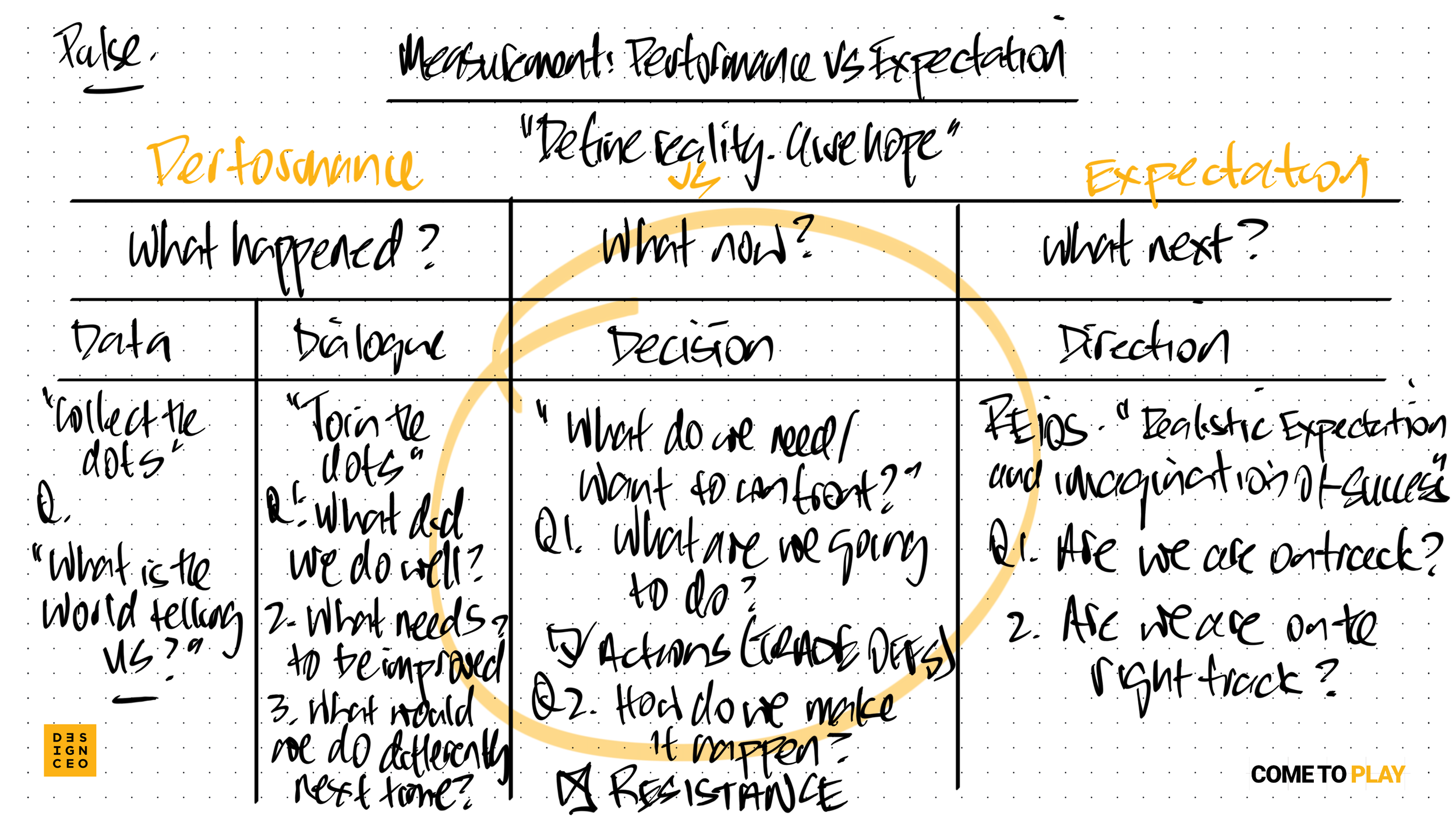
I’ve used my elite sport experience to build a system for leaders—a half-day monthly ‘pulse check’ to answer three questions.
“What happened?”
“What now?”
“What next?”
It is a process of joining the dots, but first, we collect the dots, drawing as much feedback as we can, starting with a broad-based feedback question such as, “What is the world telling us?”, then drilling down with data and dialogue (not monologue, either your voice or other dominant voices), and answering three further questions, focused on the behaviours that produced the outcomes:
“What did we do well?”
“What needs to be improved?”
“What would we do differently next time?
At all times, leaders need to align, and sometimes realign, with an agreed and committed direction, a compelling story, such that it brings together a multifarious group of individuals, each with their own ambitions, egos, and expectations, to a powerful collective purpose.
The framework I use for setting direction is called REIOS, inspired by Chris Tipler’s work ‘Corpus RIOS’, which stands for ‘Realistic Imagination of Success’. I have added an ‘E’ to capture the ‘expectations’ that form part of strategy and direction, particularly leadership's role in ‘creating the conditions’, which also relates to standards, principles, and values to embed the culture that will drive the outcomes.
Therefore, REIOS stands for ‘Realistic Expectation & Imagination of Success’ and serves as the criterion for measuring performance.
The key measure is always ‘Performance vs Expectation’, which means there must be a clear understanding of well-defined and agreed expectations and standards as it relates to this group, individually and collectively, and whatever phase of their development they are at, with questions like:
“Are we on track?”
“Do we need to change track?”
This will then be the basis for action, decisions made, again through questions such as:
“What do I/we need to confront?”
“What do I/we want to confront?”
And from that:
“What are we going to do?” - Actions and Trade-offs
“How do we make it happen?’ - Overcoming resistance to change.
The following is the framework, and you can watch the video above where I explain and construct the model. It is comprehensive, going for about 30 minutes. It has been a key piece of thinking with leaders over the last twelve months.
Use this 'pulse' check framework to strengthen your leadership system and leadership effectiveness.
Try it, and if it helps, make it part of your 2026 leadership practice.
Leadership is a craft, learned and earned.
Coaching is one of the most powerful tools for personal and professional transformation. Coaching can help you achieve great things in both your career and your life.
The rewards of being coached are twofold. To be successfully coached, you require self-awareness, humility, the ability to listen, and a hunger for feedback. But you also need a commitment to action and a willingness to be held accountable. These are the qualities you need to lead.
My role is to teach, challenge, encourage, provoke, remind, refer, prod, push, guide and cajole leaders to be the change they seek to make.
And if you are keen, let’s chat, and I will support and coach you in your efforts to:
“Build and coach your leadership system that is equal to your leadership challenge.”
Have a great Xmas.
Play on!

Stay Connected
Please subscribe to our “In the Arena” email.

From time to time to time we will email you with some leadership insights, as well as links to cool stuff that we’ve come across.
We will treat your information with respect and not take this privilege for granted.